
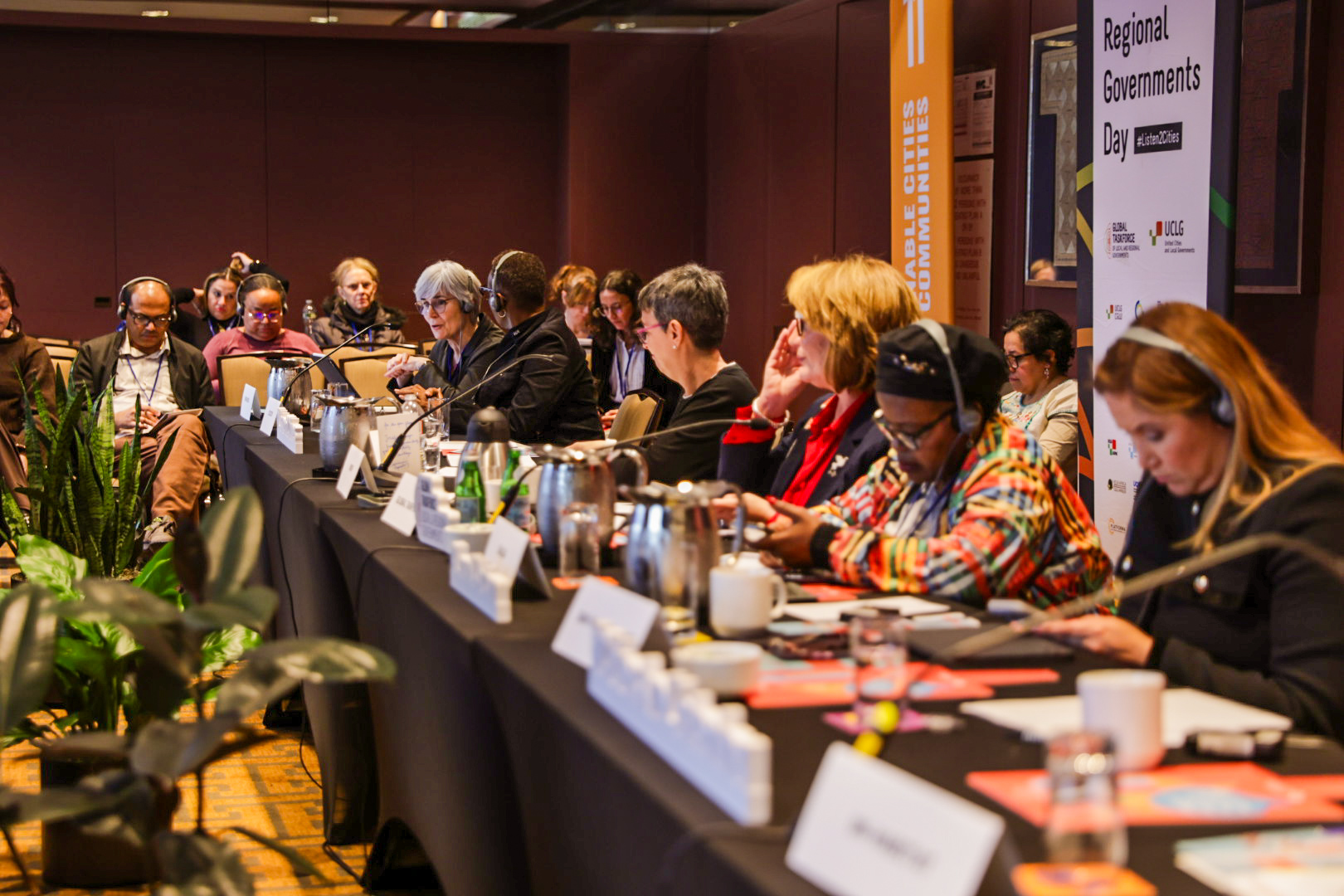
NEW YORK, MARCH 14, 2026 – In the framework of 100 Days of Local Multilateralism, more than 50 local women elected officials from all regions of the world met together with international partners and key stakeholders from the organized civil society in New York in early March 2026 on the occasion of the 70th session of the UN Commission on the Status of Women, known as CSW70.
Gathered in the Global Taskforce of Local and Regional Governments facilitated by United Cities and Local Governments, the organized constituency actively mobilized for the now traditional CSW Local and Regional Governments’ Days, despite the current geopolitical context, marked by local, regional and global important challenges that partly toned the discussions. Developed around ‘Localizing Equality, Justice and Democracy: Women’s Political Power and the New Generation of Local Public Services’, the LRGs Days are the main contribution to CSW70 focused this year on Ensuring and strengthening access to justice for all women and girls, including by promoting inclusive and equitable legal systems, eliminating discriminatory laws, policies, and practices, and addressing structural barriers, with a special focus on Women’s full and effective participation and decision making in public life, as well as the elimination of violence, for achieving gender equality and the empowerment of all women and girls.
The mobilization of the constituency and the key messages they called for at CSW70 are a key contribution to the global political agenda on Equality and set the pathway towards the 100 Days of Local Multilateralism, marking a strategic cycle of convergence of key intergovernmental moments, with the UCLG Congress and World Summit of Local and Regional Governments in Tangier in next June 2026 as an horizon. Going beyond, and as the current mandate of the UN Secretary-General is about to be renewed, the constituency of LRGs even went a step further, bringing brought its support to the global call for a “UN Madame Secretary General”, as campaigning for the appointment of a possible and wishable first female UN Secretary-General in the organisation’s 80-year history.
Reflecting this pivotal dimension of this key period for the international community, the mobilization united forces with a large number of diverse partners and allies to reinforce the political vision and advocacy work towards renewed alliances fit to better localise the Equality agenda. The message was clear: cities and territories are already advancing rights-based resilient care models that place equality at the center, through the promotion of women’s political leadership and the development of multilevel governance and partnerships—demonstrating that equality, justice and care are not only social priorities, but also cornerstones of sustainable democratic systems.
In this perspective, the organization of the Days was largely supported by a number of partners from all levels and regions of the world, including national governments, like the Governments of Mauritania as well as the Generation Equality Forum Action Coalition on Feminist Movements and Leadership (GEF AC FML, cochaired by UCLG), the Inter-Parliamentary Union (IPU), International IDEA, Global Women Leaders Voices (GWL Voices); as well as several UN agencies and bodies such as UN Women, UN-Habitat, UNDP, the OHCHR and the UN Youth Office. The LRGs Days were developed under the umbrella of the WYDE Women Leadership initiative supported by UN Women and co-funded by the European Commission.
Equality in Local Decision-Making and Democracy
Opening the first day, UN Women Deputy Regional Director for the Americas and the Caribbean Sarah Douglas recalled the need to “strengthen alliances with LRGs networks, civil society, and men to advance women's effective political decision-making, address entrenched social norms, including gendered political violence”. President of Nouakchott Region, Co-President of UCLG, Chair of the UCLG Standing Committee on Gender Equality Fatimetou Abdel Malick reaffirmed the “unity of the Municipal Feminist Movement with a collective vision of shared power, where equality is not a promise, but a lived reality”, as key component of the Local Social Covenant, and a renewed multilateralism, towards the UCLG Congress in Tangier.
Throughout this first Day, facilitated by UCLG Secretary General Emilia Saiz, discussions revolved around the global Feminist Municipal Movement driving women’s political participation, with key insights from a wide range of mayors, women local leaders and official elected, including from Mount Vernon, Bishkek, Barcelona and Niterói, and UCLG European section CEMR’s Standing Committee Equality Women and Men, who dialogued with several representatives from national, international and intergovernmental organizations and networks, including WYDE Women’s Leadership partners IPU and International IDEA; and long-standing global partner GWL Voices.
Another important segment, moderated by UCLG UBUNTU Advisor Ana Falú, addressed feminist perspectives on governance in action: renewing leadership, from political practice to institutions. Interventions from local and regional leaders -including mayors, elected officials, and leaders from national associations of LRGs from San Mateo Atenco, FENAMM and FLACMA; Regional Government of Catalonia and Diputació de Barcelona, the Östergötland Region and UCLG Standing Committee on Gender Equality, as well as SALGA- ensured the dialogue with key representatives from the international community, among others Felipe Paullier, Assistant Secretary-General for UN Youth Affairs, but also representatives from the UN Foundation, members from the GEF Action Coalition on Feminist Movements and Leadership, including the Nala Feminist Collective -NALAFEM, the Young Feminists Caucus and Young Feminists Europe, as well as Cities for CEDAW.
Local Care Systems, as a Renewed Framework for Equality
The second day opened with a keynote from Rio Hada, Chief of the Equality, Development and Rule of Law Section in the UN Human Rights Office, Office of the United Nations High Commissioner for Human Rights (OHCHR), who stressed that “Despite deep inequalities, current backlashes and growing pressures, cities worldwide are advancing resilient, rights-based care through partnerships, multilevel governance, and women’s leadership. Keeping supporting them is essential, by any means.”
It then revolved around how the Local Social Covenant advances equality with feminist movements, under the conduction of UCLG Secretary General Emilia Saiz, hand-in-hand with Nalafem Founder and Director Re’em Syeda Hussian, as member of the GEF Action Coalition on Feminist Movements and Leadership, co-Chaired by UCLG. Together, they invited speakers and participants to share views, including mayors and local representatives from Mombasa County and REFELA-Kenya, Bunyola and Fons Mallorquí for Solidarity and Cooperation, Cocody and the International Observatory of Participatory Democracy (OIDP), the Older Persons Constituency Group of the General Assembly of Partners (GAP) and the civil society organization Hope Advocated Africa, Nala Feminist Collective (Nalafem), and NGO CSW/NY.
Finally, the CSW70 Local and Regional Governments Days concluded with a moment dedicated to Local public services as commons, local care systems as equality infrastructure, where speakers from the Huairou Commission, UN-Habitat and the Global Alliance for Care (GAC) gave the change to the Basque Institute for Women (Emakunde) under the facilitation of Raquel Lagunas, Head of Gender, UNDP who reaffirmed “Care systems as core infrastructure that transform local economies and advance a feminist agenda in action”, echoing the Statement of the constituency of Local and Regional Governments gathered in the Global Taskforce, key contribution to current and upcoming CSW discussions, towards a renewed, sustained and actional local multilateralism, fit to effectively advance women’s leadership, political participation and local decision-making towards Equality for all.
Local voices ahead of pioneering actions and advancing a shared vision for Equality for everyone, everywhere
Additionally, a number of local and regional governments from the delegation took part in several parallel events and activities organised by strategic key partners and held all along the week of mobilization. By promoting this structured dialogue, LRGs not only uplifted the local perspective into the global conversation on women’s political effective participation as marking a difference in public policies, and their innovative leadership in local decision-making, but they also actively contributed to co-create a common political and strategic vision towards an inclusive multilevel leadership and multilateral governance, capable of addressing the challenges that remain ahead: from universal local public services provision to the guarantee universal access to housing, healthcare, water, sanitation, education, culture, and food security; from the prevention of all forms of violence, conflict resolution and peace-building to care-based democracy and social and climate justice.
Among those, an official side-event co-organized by UCLG with the Governments of Mauritania, Canada and Spain as well as the GEF Action Coalition on Feminist Movements and Leadership, and convened under the WYDE Women’s Leadership initiative led by UN Women and supported by the European Commission revolved around ‘Local Voices of Power: Expanding Women’s Political Participation, from Cities to Multilateralism’, directly echoing the important and long-standing work UCLG has led over the years for realizing equality in democracy, and nurturing the process of UCLG Local Social Covenant, the framework structuring the preparations of the next UCLG political mandate. In addition to high-level representatives, and answering from the field, voices from the local level included the Nouakchott Region, Catalonia, the city of West Sacramento, REFELA-Kenya, and CONGOPE.
As per the Government of Spain, Secretary of State for Equality and the Eradication of Violence against Women María Guijarro emphasized that “Equality and democracy are built at the local level [and welcomed] the UCLG’s Local Social Covenant as key to acknowledge the key role of LRGs in advancing women’s rights, care and leadership”. Standing for the national Government of Canada, Parliamentary Secretary to the Minister of Women and Gender Equality and Secretary of State Marie-Gabrielle Ménard recalled that “Grassroots engagement is essential. The success of political leadership, particularly that of women, depends on collaboration with the local level, including LRGs”. Councillor Oum Kalthoum Hamdinou from the Ministry of Social Affairs, Children and Family of Mauritania said “Representation is not enough to guarantee women leadership. We need to turn representation into real influence and expand opportunities for participation, access to networks, information, support and visibility”.
On another hand, Second Deputy Mayor of Barcelona City Council and Sixth Vice-President and Deputy for International Relations and the 2030 Agenda at Barcelona Provincial Council María Eugenia Gay marked an important stand in the global efforts made from the local level regarding the localisation and implementation of sustainable public policies for equality worldwide at the side-event ‘Intergenerational engagement for advancing young women’s leadership’. She recalled that “democracy begins where people experience it every day: in cities and territories, where, when women lead, care, social cohesion and prevention become pillars of public policy [and that] Parity in power is not symbolic, it is a democratic imperative”. The side-event, organised by UN Women together with key partners UCLG, IPU and International IDEA under the umbrella of the WYDE Women’s Leadership, reaffirmed the determination of LRGs and their networks, Member States, and key partners to create political ecosystems in which women, communities, and territories thrive and lead.
Also organized by UN Women, the meeting ‘From Words to Change: How the UN System Champions Women’s Participation in Public Life’ allowed to recall the long-standing work and close collaboration of the World Organisation with UN Women and UN-Habitat, especially regarding leveraging advocacy to keep promoting women’s leadership, including at the local level. Last but not least, chaired by UN Women Deputy Executive Director, the GEF Action Coalitions Stakeholder Dialogue was moderated by UCLG with the aim to keep defining together with partners and key stakeholders a shared vision as well as a roadmap and strategy for the future of the GE global process.
Finally, the Launch of the Report ‘Women’s Political Participation: Bridging the Leadership Gap: Women in Local Executive Office in Latin America’, jointly developed by GWL Voices and UCLG with the aim to develop data and tools to advocate for more women leaders into decision-making at all levels, including in local offices -with only 17% of locally elected mayors being women. This was the opportunity for Prefect of Esmeraldas and Vice-President of CONGOPE to recall that “Local political leadership is the starting point to challenge the social norms that expect [women] to remain doubtful and silent, and UCLG Secretary General that “The architecture of governance requires bold and deep transformation and the feminist shift lies in turning the personal -which is profoundly political- into public policy.”
The road ahead
All in all, the 70th session of CSW offered the opportunity and provided the space for local and regional government level to keep informing the conversation on the crucial need to empower women in politics and ensure that they can access, remain and influence decision-making positions in order to guarantee the localization of justice and democracy, towards a new multilateralism rooted in Equality and Care. In the coming months, local and regional governments will continue informing the global conversation towards a shared vision on Equality, with the Tangier UCLG World Congress as a cornerstone of the 100 Days of Local Multilateralism, alongside the review of the New Urban Agenda and the World Urban Forum (17-22 May, Baku), the 2026 UN High-Level Political Forum and the review of SDG11 (7—15 July, New York), and beyond.
→ Read the Statement of the Global Taskforce of Local and Regional Governments at CSW70.