
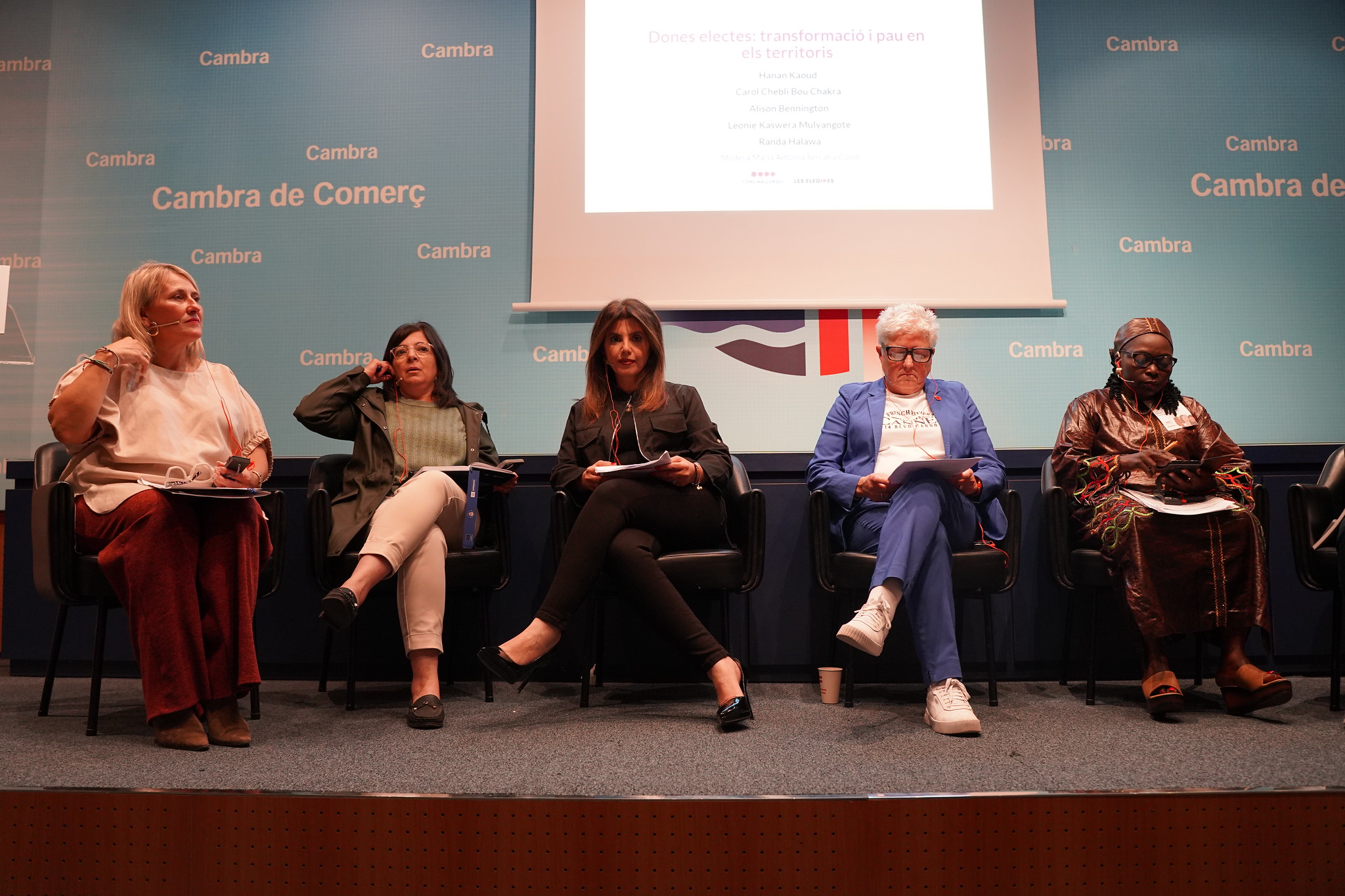
Palma de Mallorca, November 6-7, 2025.
More than one hundred locally elected women from Spain, Ireland, Peru, Bolivia, Togo, Senegal, the Democratic Republic of the Congo, Palestine, Morocco, and Lebanon, as well as researchers and civil society representatives, gathered in Palma de Mallorca on 7 November for the II International Meeting of “Les Elegides”. It was organized by the Fons Mallorquí de Solidaritat i Cooperació, with the contribution of United Cities and Local Governments (UCLG) through the WYDE Women’s Leadership initiative, funded by the European Union and led by UN Women.
Beyond access: Confronting violence to ensure women’s lasting participation in local politics
Following the opening of the event by representatives of the Fons Mallorquí and Consell de Mallorca, the discussions went beyond the question of women’s access to local political office to address the challenge of permanence: how to ensure that women not only enter but remain in politics, despite the multiple forms of violence and discrimination they face.
Violence is a strategy of intimidation and exclusion that seeks to silence and eclipse women before, during, and after they take office. Participants highlighted this violence—from direct harassment to economic and/or social marginalization, from delegitimation and defamation to public disruption and trust breaching strategies or organized campaigns—as a structural barrier that undermines women’s political careers and, ultimately, democracy itself. Speakers stressed that parity alone is insufficient unless political violence—both emerging and normalized, online and offline—is recognized and addressed.
Overall, the meeting showcased initiatives that prepare and support women in political life, such as mentorship programmes in Togo, capacity-building efforts in Ireland, and actions in Senegal linking political empowerment with women’s economic autonomy. Participants from Palestine and the Democratic Republic of the Congo also underlined the role of locally elected women in resilience and peacebuilding, particularly in territories affected by conflict.
From challenges to action: Changing norms, building capacities and strengthening networks
Addressing social norms and power relations also emerged as a priority, a message that resonates strongly with the ongoing work of the global Feminist Municipal Movement led by UCLG and its contribution to Beijing+30 celebrations, positioning local governments as key actors in advancing gender equality. The discussions during the event were recognized as a significant contribution to the upcoming 25N -standing for 25 November International Day- global campaign for the Elimination of Violence against Women and Girls and the 16 Days of Activism against Gender-Based Violence, including the UNITE to End Violence against Women Initiative.
In terms of capacity-building, participants highlighted priorities such as strengthening networks of locally elected women, enhancing leadership and communication skills, providing psychological support, and addressing the economic barriers that limit women’s participation. They proposed innovative ideas for training, such as role-switching exercises in local councils, online exchanges to foster international movement-building, and the creation of solidarity funds for women candidates. As one participant summarized: “Parity is not the end goal: it is the beginning. What we need is permanence, protection, and power.”
The event reaffirmed that the future of democracy depends on the full, safe, and sustained participation of women—in every territory, at every level, in all public domains.